


Short Let or Long Let in Malta: Which Earns More for the Owner?
If you own an apartment in Malta, the question comes up sooner or later: do you let it to guests by the night, or to a tenant by the year?
For most apartments, a professionally managed short let earns more. It also takes more work and comes with more rules, which is why most owners hand it to a manager. This guide uses our own booking data to show what each route looks like in practice.
The short answer
A professionally managed short let usually earns more than a long let, and not only in the main tourist areas.
A short let does have more costs to cover: platform commission, VAT, cleaning and utilities. Good management is what makes the numbers work: pricing that follows demand, a calendar kept full outside the summer peak, and a property kept in top condition. A long let still suits some owners, mainly those who want one fixed payment and no involvement at all. For a closer look at short-let income, see our 2026 guide to what a short let really earns.
What a short let earns in Malta
These figures come from the apartments we manage that had a full 12 months of bookings. They show what guests paid, before any deductions.
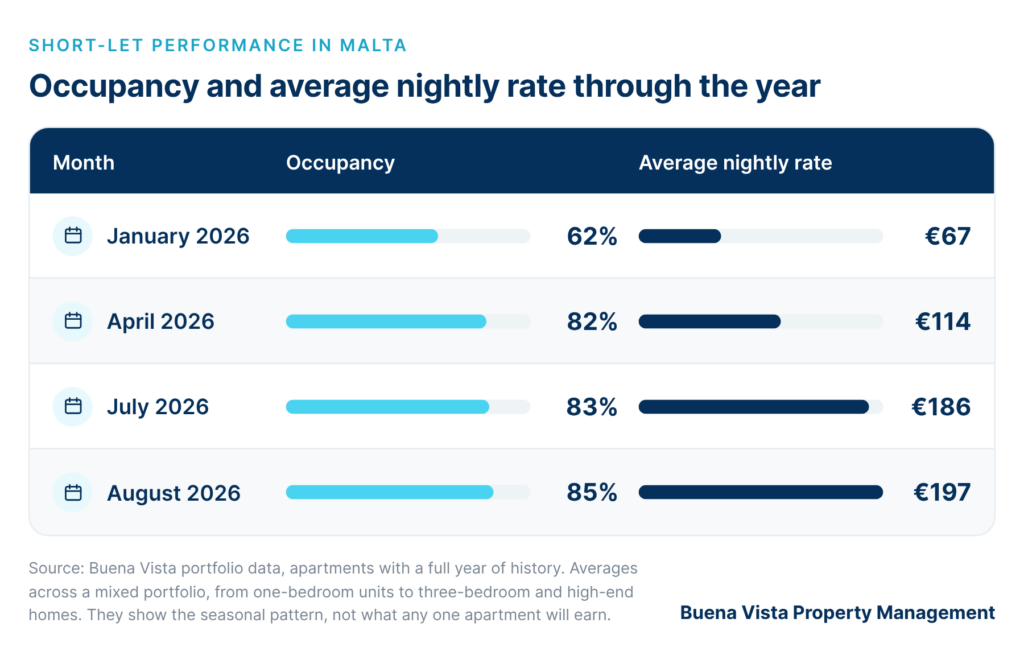
Your own figures depend on size, finish and location; we work them out from comparable apartments.
Two things stand out.
- Summer carries the year. The average nightly rate in August was nearly three times the January rate. Pricing that rises with demand makes the most of the peak.
- Occupancy holds up all year. Even in January, these apartments were 62% occupied. Demand is there in winter; it is the rate that moves.
Short lets work beyond the tourist hotspots
Owners often assume a short let only works in Sliema or St Julian’s. Our own portfolio says otherwise: we manage blocks in Għaxaq, Burmarrad and Għargħur, well away from the main tourist areas, and all rent well. Location matters, but presentation, pricing and reviews decide most of the result.
What professional management adds
A short let is a hospitality business. The gap between an average result and a strong one usually comes down to pricing reviewed every day against market data, listings on the main booking platforms, fast replies to guests, and cleaning and maintenance done to a standard that earns good reviews. Our own team does that work for owners, which is why a well-run short let tends to stay ahead of a long let even after costs.
What a long let earns
A long let pays the same rent every month, whatever the season. These are median monthly rents for two-bedroom flats registered with the Housing Authority in the first half of 2025, the latest locality figures published:
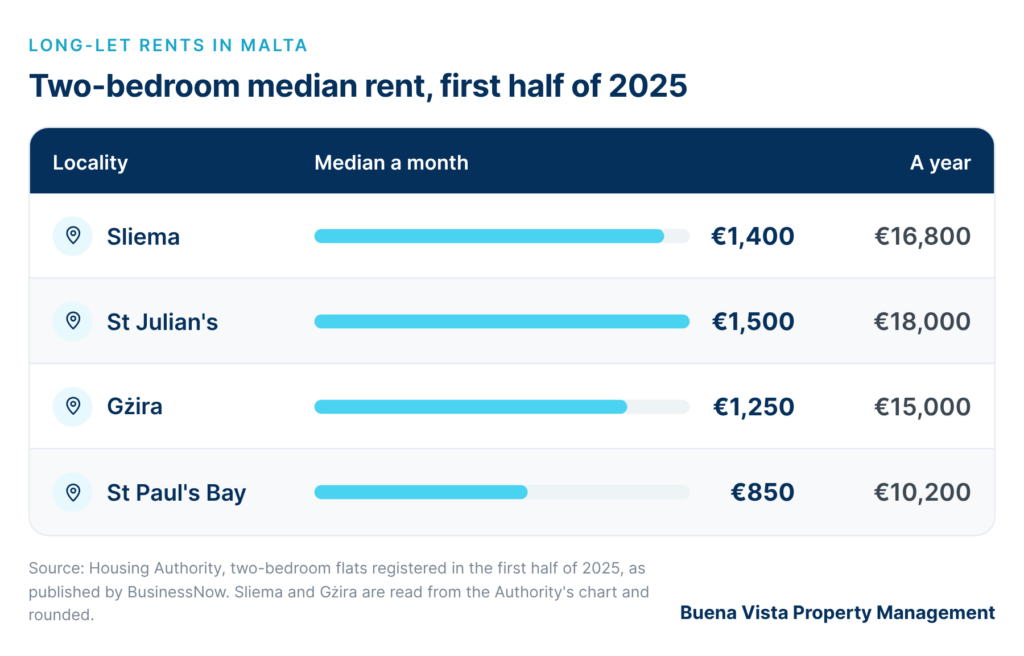
Long lets also have a simple tax route. Landlords can choose a 15% final tax on gross rent, with no deductions, or declare the rent in their annual return and claim allowable deductions (Chetcuti Cauchi). You can switch between the two from year to year. Ask your tax adviser which suits you.
A fixed rent is also less fixed than it looks. Under Malta’s rental law, a tenant can end the lease early by giving notice. The property can then sit empty for a month or two while you find the next tenant, and you may pay another agency fee each time.
Side by side: what each route involves
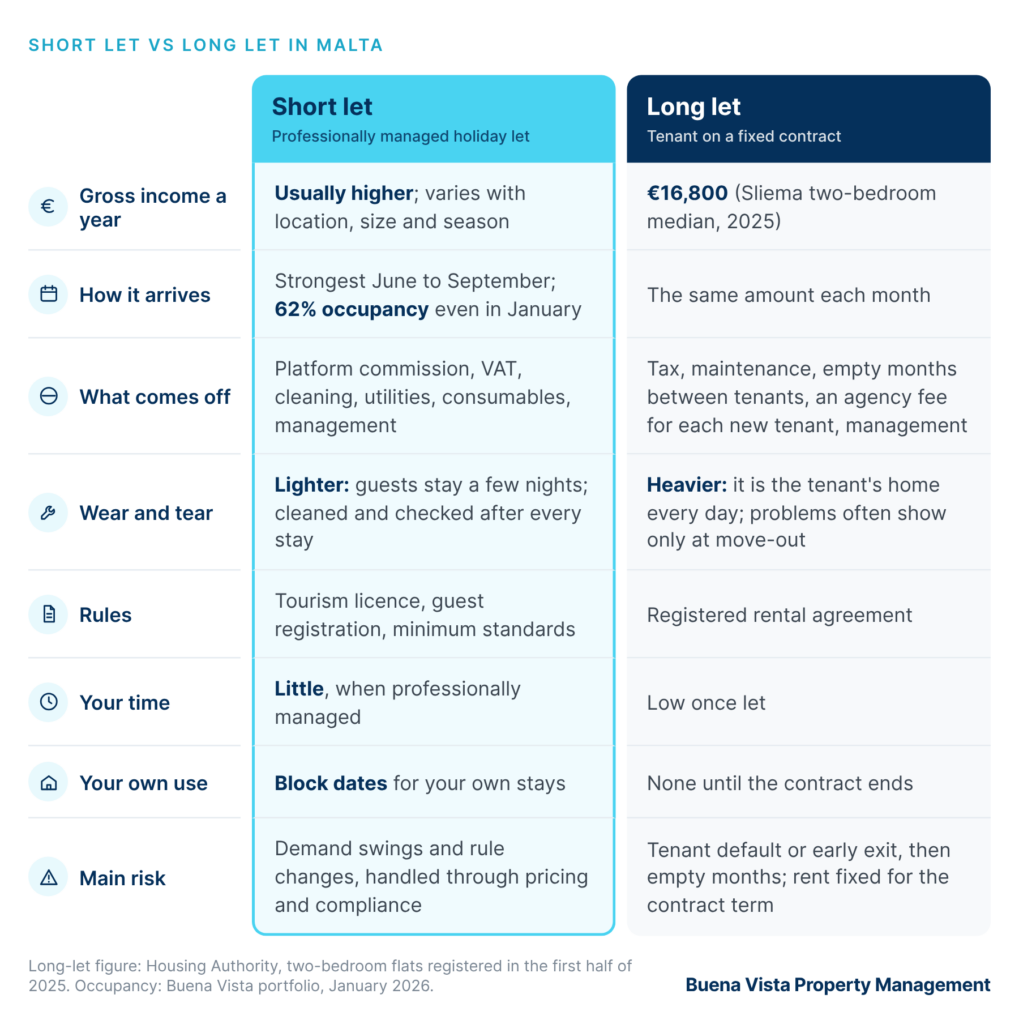
Short-let income depends too much on the individual apartment for one honest figure, so we work it out property by property from comparable apartments we manage.
Short-let revenue does carry more deductions. Platform commission and VAT take roughly a quarter, with cleaning and utilities on top. In our experience, though, a professionally managed short let earns enough more than a long let to stay ahead after those costs, and the property usually ends the year in better condition. Ask your accountant how VAT and income tax apply to your own situation.
When a long let can make sense
- You want one fixed payment and no involvement at all. A long let means one tenant, one monthly payment and very few decisions.
- The building may not allow short lets. Check the deed and the building’s rules before you plan around nightly bookings.
- The apartment needs work before it can compete. Guests compare photos and reviews, so a dated apartment may be better long let until it is refreshed, or refreshed first.
- You would rather not deal with licensing at all. Short lets need a tourism licence, and minimum standards, although a manager handles most of this for you.
If a long let fits, see how our Long Let Management service works.
A middle option: fixed rent with a managed let
If you want certainty without giving up the short-let market, there is a third route. Under our Subletting Solutions service, you receive a fixed monthly payment whatever the occupancy, and we manage and sublet the property.
The trade is simple: you give up the upside of a strong summer in return for knowing what arrives each month.
How to decide
- What is the property like? Presentation, layout and finish matter as much as the locality. Well-run apartments in quieter villages can do well too.
- Do you need the same amount every month? If so, a long let or our fixed-rent option fits. If seasonal income is fine, a short let usually earns more over the year.
- How involved do you want to be? Short lets need daily management, so most owners hand them to a professional.
- What do the building and the licensing rules allow? Check this before anything else.
- Will you want to use it yourself? With a short let you can block dates for your own stays. A long let ties the property up for the contract term.
If you’re still unsure, tell us about the property. We’ll talk you through which model fits and, for short lets, show projections based on comparable apartments in our portfolio.