


Where the Real Money is Made
If you’re researching where to buy or manage a short-let property in Malta, you’ll find no shortage of opinions — everyone has a favourite neighbourhood. What’s harder to find is actual data. So we pulled together two years of real booking performance alongside independent market research covering every corner of the island, to see what short-let performance in Malta actually looks like — area by area, including a few results that surprised us.
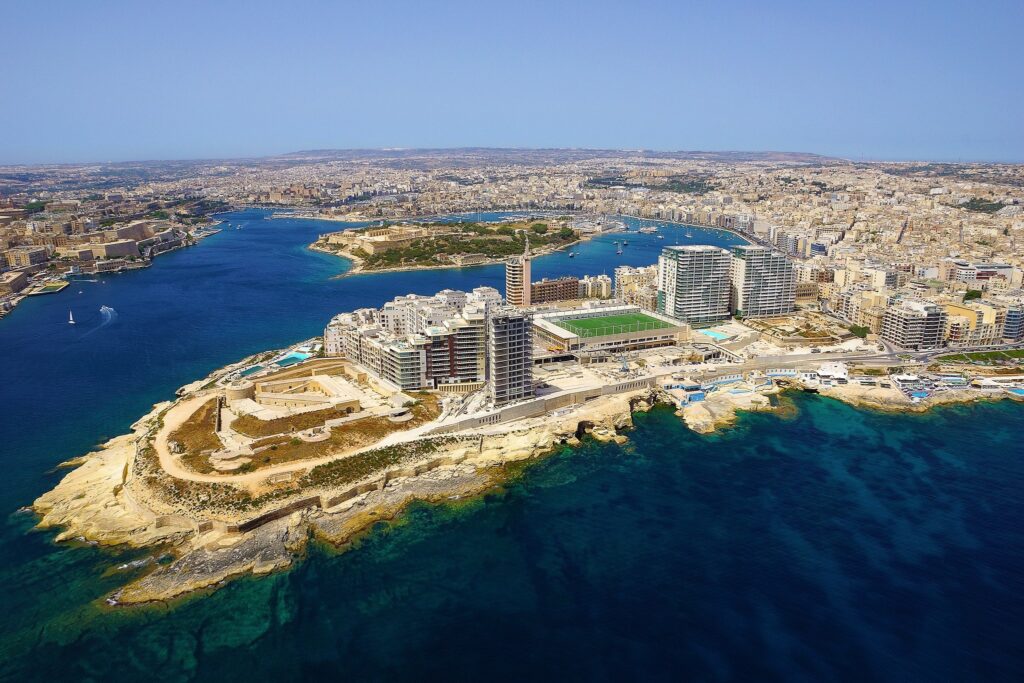
The established hotspots: Sliema, Valletta and Saint Julian’s
These three names come up in every conversation about short-let property in Malta, and the numbers back up the reputation — with one important nuance most owners never hear about.
Sliema remains the volume leader, with by far the highest number of short-let properties on the island, a strong average daily rate (ADR) of around €145, and occupancy of roughly 72%.
Saint Julian’s performs similarly well, with an ADR around €142 and occupancy of 71%, driven by its proximity to Paceville’s nightlife and the Spinola Bay seafront.
Valletta, Malta’s capital, edges out both — the highest ADR of the three at around €157, with the strongest occupancy at 75%. And as we’ll get to below, it does something the other two don’t.
The stability factor nobody talks about: Valletta vs Sliema
Here’s a finding that surprised us enough to dig deeper: Valletta is significantly more stable across the seasons than Sliema.
On an independent seasonality index (0–100, where a higher score means more stable year-round demand), Valletta scores 73, while Sliema scores just 49. Valletta’s own winter average daily rate holds at roughly half its summer peak (€87 vs. €185), while Sliema’s winter rate falls to less than a third of its August high (€64 vs. €206).
Why? Valletta draws a genuinely different mix of demand — cultural tourism, business travel, and city breaks that continue through the winter — while Sliema’s demand is more purely beach-and-summer driven. For an owner weighing where to buy, this is a real, practical difference: a Valletta property is more likely to generate steady income across twelve months, while a Sliema property will earn more at its peak but needs a stronger off-season strategy to avoid a quiet winter.
Presentation over postcode: what one Senglea property proves
Area reputation isn’t the whole story, and one property in Senglea (L-Isla), one of Malta’s historic “Three Cities,” makes that point clearly. Senglea as a whole is a modest-performing area — its typical ADR sits well below the established hotspots. But a single 3-bedroom luxury townhouse we manage there, with a pool and harbour views, averages €355 a night — more than double even Valletta’s rate, and nearly four times what the area typically commands.
That property alone generates over half of all Senglea revenue in our portfolio, despite representing less than a third of the bookings. The lesson isn’t “buy in Senglea” — it’s that presentation, quality, and positioning can matter more than a neighbourhood’s average reputation. A genuinely exceptional property in an unfashionable postcode can outearn an ordinary one in an expensive area. The area sets a ceiling on what’s typical; execution decides what’s possible above it.
Birgu (Vittoriosa), Senglea’s neighbour in the Three Cities, is a steadier example of the same broader area — a solid €118 ADR with 74% occupancy, one of the highest occupancy rates we found anywhere on the island.
Areas worth watching: Mellieħa, Marsaxlokk and Marsaskala
These three towns are also genuinely worth an owner’s attention.
Mellieħa stands out immediately: despite having by far the largest short-let supply of the three (551 active listings), it still commands the highest average daily rate of the group at €154, with a healthy 67% occupancy. That combination — high supply and high rate — is a strong signal of deep, sustained demand rather than a market running out of steam.
Marsaxlokk, the famous fishing village, posts a solid €131 ADR at 68% occupancy across a much smaller pool of listings (90), suggesting a market with real pricing power that hasn’t yet been oversupplied.
Marsaskala rounds out the group with a €123 ADR and the strongest occupancy of the three at 70%, across 415 listings — a steady, reliable performer rather than a spectacular one.
A word on Gozo
Malta’s sister island plays by slightly different rules. Xagħra, home to the Ġgantija Temples, posts a strong €154 ADR but with the lowest seasonality score we measured (45) and 55% occupancy — a market that leans hard into summer demand and quiets down significantly outside it. If you’re considering a Gozo property, plan your pricing and expectations around that rhythm rather than assuming mainland patterns apply.
Rate is only half the story: factoring in purchase cost
A high ADR doesn’t automatically mean a high return — it depends what you paid to get it. Purchase prices per square metre vary dramatically across these same areas, and that gap is often larger than the gap in nightly rates.
Based on current market listings data, typical purchase prices run roughly:
- Sliema and Saint Julian’s: €4,000–€7,500/sqm, with ultra-prime pockets (Portomaso, Tigné Point) reaching €9,000+/sqm
- Valletta: €5,000–€7,500/sqm for the historic core
- Gżira: €4,000–€5,500/sqm, a step below Sliema and Saint Julian’s
- The Three Cities (Senglea, Birgu, Cospicua): considerably lower, more in line with Malta’s affordable heritage-area pricing than with the prime coastal strip
Put a rough number on it, and the picture changes. A 70 sqm apartment earning Valletta’s ADR and occupancy generates an estimated €43,000 a year in room revenue, against a purchase price in the region of €350,000–€525,000 — a gross yield of roughly 8–12%. The same size property performing at Birgu’s rate and occupancy generates around €32,000 a year, but against a purchase price likely closer to €175,000–€260,000, given the area’s lower entry cost — a gross yield in the region of 12–18%.
The nightly rate difference between these two areas is real, but the purchase price difference is larger — which means the less expensive area can deliver the stronger return, even with a lower ADR. These are illustrative gross figures only (before commission, maintenance, taxes, and financing costs), and actual purchase prices vary significantly by building, condition, and exact street — but the principle holds: always weigh rate and occupancy against entry cost, not against each other in isolation. An area’s reputation for high nightly rates doesn’t automatically make it the better investment once the purchase price is factored in.

What this actually means if you’re choosing where to invest
A few honest takeaways, not sales pitches:
- If you want steady, year-round income, Valletta’s stability is a genuine structural advantage over the more seasonal coastal hotspots.
- If you want to maximise peak-season earning potential and can manage a stronger winter strategy, Sliema and Saint Julian’s still deliver the highest volumes and strong rates.
- Don’t assume a modest area caps your potential. The Senglea townhouse shows that an exceptional property can far outearn its area’s typical rate, even one well below the mainstream hotspots.
- Mellieħa, Marsaxlokk and Marsaskala are all legitimate options with real, proven demand — not fringe bets.
- Always weigh rate against purchase cost. A lower-ADR area with a proportionally much lower entry price can out-yield a hotspot on paper, even if it never wins on nightly rate alone.
Methodology note
Figures in this article draw on a combination of our own booking history across the properties we manage and independent short-let market research covering areas across Malta and Gozo.
Curious what a specific area could mean for your own property? Our revenue management team works with real, comparable data like this every day.
Get in touch for a property-specific estimate rather than a market average. →