


How Much Can You Really Earn From a Short-Let in Malta? (2026 Guide)
If you own a property in Malta and you’re weighing up short-let versus long-let, or wondering whether professional management is actually worth the commission, the question underneath all of it is usually the same: what will this property actually earn me?
It’s a fair question, and it deserves an honest answer rather than a headline number pulled from a listing site’s best-case scenario. We’ve been managing properties across Malta for over 15 years, and every projection we give an owner is based on real numbers from comparable properties we actually manage — not a hopeful estimate designed to win the business. We’d rather be accurate upfront than have an owner disappointed six months in; we’re in this for a long-term relationship, not a single sign-up. Here’s what actually determines your return, and how to think about it realistically.

There’s no single “average” — location and amenities do most of the work
A studio in Sliema, a two-bedroom in St Julian’s, and a converted farmhouse in Rabat are not competing in the same market, and quoting one blended “average nightly rate for Malta” would hide more than it reveals. What genuinely moves the number:
- Proximity to the seafront, ferry links, and nightlife areas (Sliema, St Julian’s, Valletta) commands a premium over inland towns
- Walking distance to the promenade or a beach matters more to guests than almost anything else in the listing
- Parking availability is a bigger differentiator than owners often expect, especially for guests arriving by car
- View — sea view versus a courtyard-facing unit can meaningfully shift what a property can charge, even on the same street
- An authentic village setting can be just as strong a draw as a seafront location, for a different type of guest — properties near local bakeries, grocers, and family-run shops, surrounded by Maltese neighbours rather than other tourists, appeal strongly to guests looking for a genuine local experience rather than a resort-style stay
- Amenities like a pool, hot tub, or private terrace can meaningfully lift both your achievable nightly rate and how often a listing gets booked — guests actively filter for these features on booking platforms, so a property with a pool or hot tub isn’t just more appealing, it’s often more discoverable in the first place
This is why a proper income estimate has to be property-specific, not a generic percentage applied to your purchase price.
Occupancy matters more than nightly rate
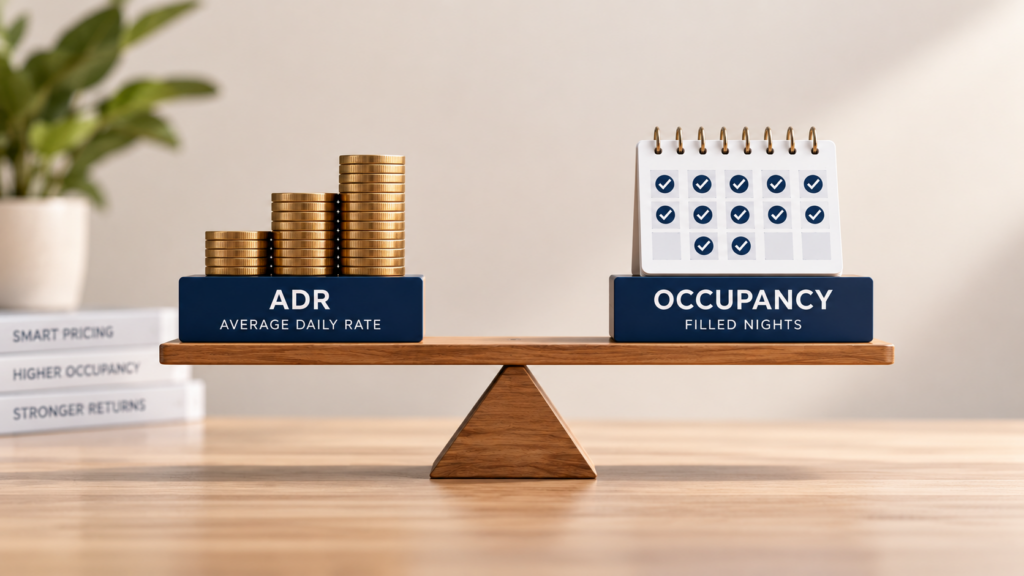
It’s tempting to focus on the nightly rate a property could charge, but income is a function of rate times occupancy — and occupancy is where inexperienced self-management most often loses money. A property priced too high sits empty; priced too low, it fills up but leaves money on the table. Getting this balance right, and adjusting it continuously through the season rather than setting it once, is genuinely the difference between a property that performs and one that underperforms relative to its potential.
This is also the single biggest reason professional short-let management earns its commission: pricing isn’t a one-time decision, it’s a constant, data-driven adjustment based on demand, local events, and how comparable listings are performing in real time. At Buena Vista, this isn’t an occasional check-in — we have a full-time revenue manager supported by an AI-based pricing system, working continuously to find the right balance between nightly rate and occupancy for each property, rather than leaving pricing on autopilot.
Seasonality in Malta is real, but it’s not as extreme as some owners assume
Malta’s peak season (roughly June through September) commands the highest rates, but the shoulder seasons — spring and autumn — have grown considerably as a market in recent years, driven by remote workers, retirees, and travellers avoiding peak-summer heat and crowds. A well-managed property with sensible off-season pricing can maintain meaningful occupancy well outside the traditional summer window, rather than sitting empty from October to April.
We see this firsthand: after more than 15 years in this business, we have a genuine base of returning guests who book with us specifically for the winter months, choosing Malta’s mild climate over a cold Northern European winter. Winter occupancy isn’t a hopeful theory for us — it’s a pattern we see repeat year after year.
What actually comes off the top
A realistic income picture has to account for costs, not just revenue — and this is where owners are sometimes caught off guard, whether managing independently or comparing management companies:
- Management commission — varies by provider and service level
- Cleaning between stays — a genuine, recurring cost that scales with occupancy (and one worth getting a clear, itemised quote for, rather than an estimate that turns out to exclude linen or high-turnover fees)
- Maintenance — both routine upkeep and the occasional unexpected repair
- Utilities — increasingly significant given Malta’s utility rates, particularly for higher-occupancy properties
- Malta’s Eco Contribution (tourism tax) — typically passed through to the guest rather than absorbed, but worth confirming how your current setup handles it
None of these individually should be alarming, but a rough gross income figure that ignores all of them isn’t a real number — it’s a marketing number.
This is worth underlining, because it’s the point most owners miss when comparing management companies: the headline commission percentage matters far less than how much actually ends up in your pocket at the end of the year. A lower commission can look attractive on paper while a company quietly recovers the difference through inflated cleaning fees or other add-on charges. The only number that really matters is the net one — what’s left after every cost is accounted for, not the one a company’s sales pitch chooses to lead with.
Furnishing and presentation genuinely change the outcome
This is one of the more overlooked levers. Two otherwise identical apartments — same building, same view, same size — can perform very differently based on how they’re presented. Professional photography, a well-thought-out interior, and small details (good lighting, a functional workspace, quality linens) all influence both your nightly rate ceiling and your conversion rate on booking platforms. It’s a real, measurable input into ROI, not just an aesthetic preference.
We take this seriously enough to have a dedicated Head of Hospitality, whose entire role is making sure every property we manage isn’t just well-maintained, but genuinely presentable and guest-ready — not only when a listing first goes live, but consistently, stay after stay.

Short-let vs. long-let: a different kind of return
It’s worth being honest that short-let isn’t automatically the higher-earning choice for every property or every owner. Short-let management generally offers higher gross income potential in the right location, but with more variability, more operational involvement (or a higher management commission to remove that involvement), and more exposure to seasonality. Long-let offers a lower but far more predictable monthly income, minimal guest-facing admin, and a fixed commission model.
Some property types genuinely perform better as a long-let than a short-let, and we’ll tell you when that’s the case rather than steering every owner toward whichever service suits us best — if you’re purely optimising for maximum financial return, we’d rather be upfront that a particular property is better suited to long-let than push you toward short-let regardless. That said, short-let isn’t only about the numbers: it also means you can still use the property yourself when you want during the year, and it typically sees less wear and tear than a long-term tenancy. Which option actually suits you depends on your property, your risk tolerance, and how hands-off you want to be — not on which one sounds more impressive.
So, what will your property actually earn?
Honestly, the only credible answer is: it depends on enough specific factors that a real number requires looking at your actual property, not a blog post. What we can tell you, based on managing properties across these same locations and property types for over 15 years, is what a realistic range looks like once we’ve seen the unit, its location, and its condition — and where the biggest opportunities are to improve on that baseline. In some cases, that includes practical improvements or upgrades to the property itself, which we can help guide, specifically aimed at lifting achievable rental income rather than just cosmetic changes.
If you’d like an honest, no-obligation estimate based on your specific property rather than a generic market average, we’re happy to walk through it with you.